Volume 2. Solovki GULAG
Physical-geographical Review
"The Solovetsky Islands (Russian: Соловецкие острова), or Solovki (Соловки), are an archipelago located in the Onega Bay of the White Sea, Russia. Area: 347 square kilometers (134 sq mi). "
( The Solovki Encyclopedia )
"I very much would like, that in the future, the grandiose sanatorium for entire North would be arranged here, on Solovki..." (M.Prishvin. 1933)
Average temperatures are +11°C...
In spite of the proximity to the Polar Circle and the medieval name of the White Sea ( Icy-Cold), the frigid cold of the North is not felt here. The Solovki microclimate is soft and pleasant. Absence of cold currents, proximity to the mainland and the predominance of winds from the west created a more continental microclimate than, for example, the climate of Arkhangelsk or Murmansk. Average temperatures during the year are +11°C, the coldest month - February, the hottest - July. The temperature ranges within 11-12ºC, and differs in winter and summer only in terms of the mathematical sign. This fact, of course, does not mean that stable temperatures are guaranteed each season: it can be 30ºC both in summer and in winter. It is quite pleasant though. This peculiarity can be interesting and useful while walking around Solovki both in summer and in winter.
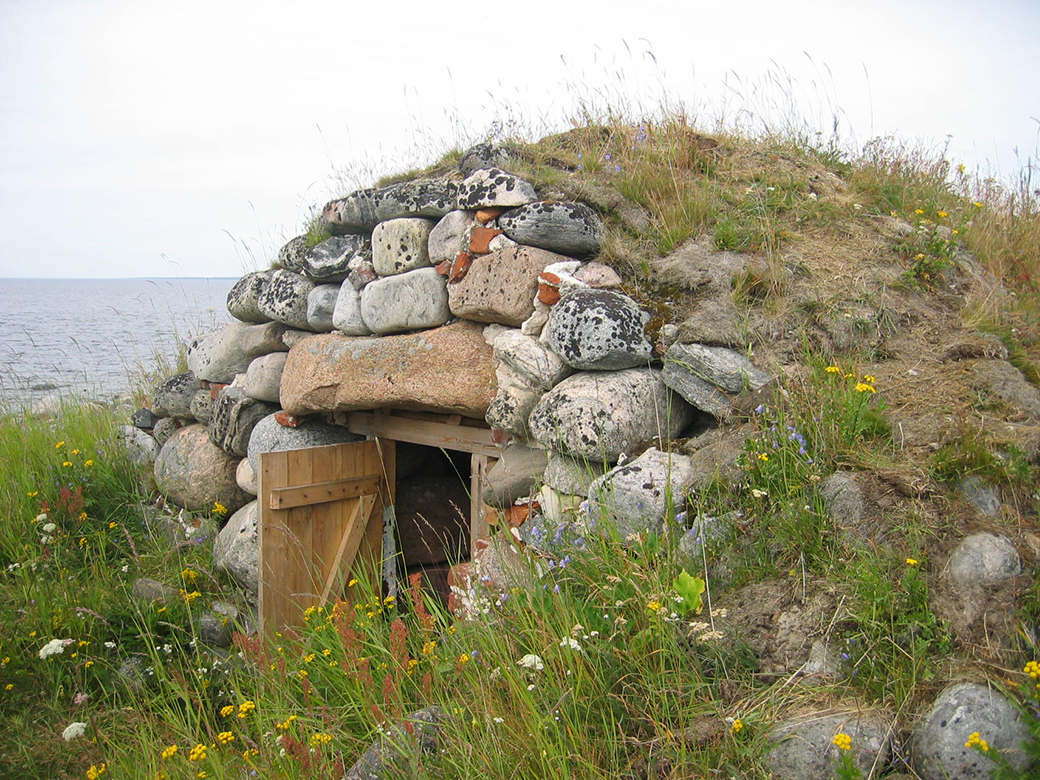
The topography of the Solovki Islands is rough, it abounds with small lifts and slopes. G. Bogoslavsky wrote: "It is possible to identify three basic zones on Bolshoi Solovki Island: the central part of the island with a hilly-elevated landscape and numerous lakes; the southern part representing a hollow, surrounded with heights, covered with peat moss and overgrown lakes. Between inclines and slopes of the hilly elevated landscape there are cavities filled with water. These are well-known Solovki lakes, the exact amount of which it is not known even today.
There are no significant elevations on the islands. But all the existing hills are proudly called "mountains". Almost all of these "mountains" are located in the central part of Bolshoi Solovki Island. The sloping Khlebniye Mountains are situated to the east from the Kremlin and according to legend, monks carried out experiments sowings spring grain crops here. There are the Valdai Mountains to northwest from the monastery. The chain of Setniye, Gremyachiye and Volchiye mountains are located in the area of the Red lake. The highest mountain of the archipelago was mentioned above* *(see encyclopedic information). The most well-known Solovki mountains are: the mountain Sekirnaja on Bolshoi Solovki Island, the mountain Favor on the Bolshaya Muksalma Island and the mountain Golgotha on the Anzer Island. The names of these mountains are connected with monastery history.
The direction of all heights and lake hollows obviously indicates the route of the last glacier. It moved from the north and northwest to the south and southeast, leaving after itself the heaps of boulders and rubble, laying the axes of future lakes. The Bolshoi Solovki Island is extended in this direction. Then the glacier has changed its direction, having turned almost to 90º. This turning can explain the difference in the position of some elements of a local relief: quite often nearby lakes or lowlands may differ in to height above sea level.
Natural exposed moraine rock on the islands is few, in spite of the explicit traces of the glacier. Thus the soil layer is thin: 3-25 centimeters. Soil scientists have identified podsolic, a transitional form to semi-swamp, transitional from semi-swamp to marsh, marsh and peat soil complexes on the islands. By the way, the reserves of peat moss on Solovki are huge - more than 80 million tons. Many Solovki swamps are the relics of ancient geological epochs.
In spite of a thin soil blanket which covers the islands, practically all kinds of northern vegetation – from tundra to taiga thickets – flourish here. Conifer forests cover up to 90% of the surface of the archipelago. Solovki is in a transitional zone for two kinds of fur-trees - Siberian and European. Mixed woods occupy about 9 % of this area. Only 1 % is the tundra vegetation growing, basically, in the coastal zone. The abundance of berries on the islands (cloud berry, cranberry, crowberry, bilberry, blueberry) reminds us of the wildness of this locality. At the same time the archipelago has an impressive culture: almost six centuries man has laboured on Solovki. The results of these works were all but destroyed by the Soviet Regime: today Solovki sometimes resembles a neglected landscape park.
Поделиться в социальных сетях